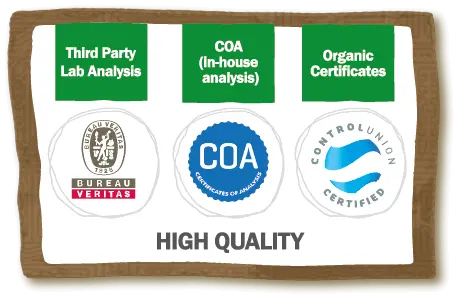
In the B2B superfood ingredient market, certifications aren't just nice-to-have — they're essential gatekeepers. Major retailers, supplement brands, and food manufacturers require documented proof of food safety, organic status, and sustainability compliance before any purchase order is issued.
HACCP & GMP: Food Safety Management
HACCP (Hazard Analysis and Critical Control Points) is the internationally recognized food safety system that identifies, evaluates, and controls hazards throughout the production process. Combined with GMP (Good Manufacturing Practices), it ensures: validated hazard analysis specific to maca processing, critical control points monitored at every stage, environmental monitoring for contaminants, traceability from field to final product, and regular audits by accredited certification bodies.
USDA Organic (NOP)
USDA National Organic Program certification confirms: no synthetic pesticides or fertilizers used in cultivation, no irradiation or genetic modification, segregated processing to prevent commingling with conventional product, and annual inspection of the entire production chain. Verification: search the USDA Organic Integrity Database at organic.ams.usda.gov.
EU Organic (EC 834/2007)
Required for selling organic maca in any EU member state. Covers the same principles as USDA but with additional requirements around soil management and biodiversity. Since 2022, the new EU Organic Regulation (EU 2018/848) has replaced the older framework with stricter import controls.
Canada Organic (COR) & JAS (Japan)
Canada Organic Regime (COR) certification is required for the Canadian market — one of the fastest-growing organic supplement markets globally. JAS (Japanese Agricultural Standard) certification opens access to Japan's premium health food sector, where organic maca commands significant price premiums due to strict import quality requirements.
Halal & BioComercio
Halal certification (IFANCA, ISWA) is essential for markets in Southeast Asia, Middle East, and the growing Muslim consumer segment globally. BioComercio (BioTrade) certification validates sustainable sourcing practices, fair trade with farming communities, and biodiversity conservation — increasingly demanded by European and conscious-consumer brands.
How to Verify Any Certification
Never trust a PDF alone. Every legitimate certification can be independently verified: USDA Organic — organic.ams.usda.gov, EU Organic — TRACES NT system, Halal — contact the certifying organization directly with the certificate number, BioComercio — through UNCTAD BioTrade verification channels.